

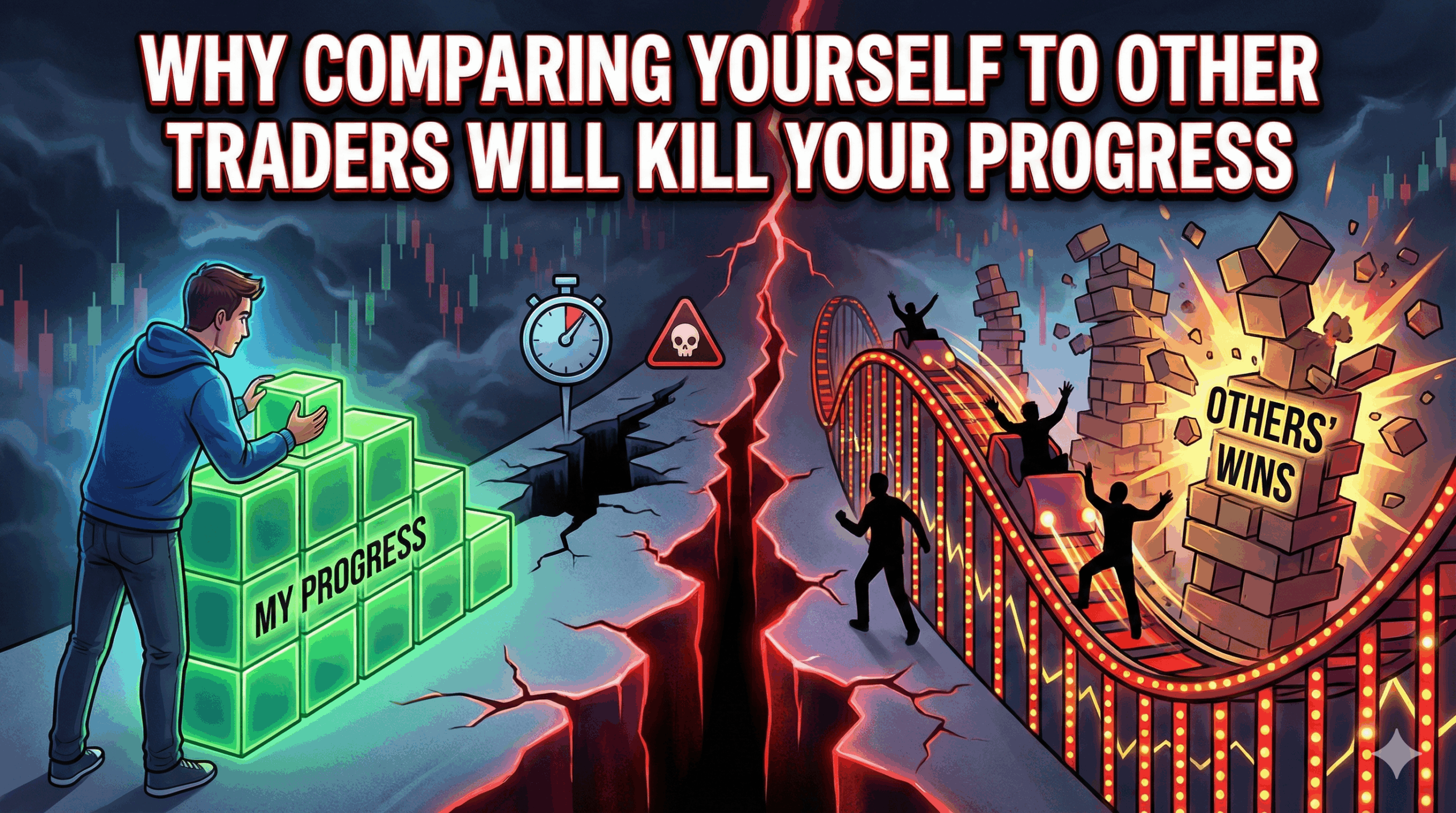
Scrolling through trading Twitter or Instagram will make you feel like you are the only person losing money. Everyone else seems to be crushing it. Five figure days. Consistent green weeks. Perfect entries and exits. Meanwhile, you are fighting to stay above breakeven and wondering what you are doing wrong.
Here is what nobody tells you. Comparison is not just discouraging. It actively destroys your trading progress. Every minute you spend comparing yourself to other traders is time stolen from building your own skills. Every time you feel inadequate because someone else’s results look better, you make decisions that sabotage your development.
Your trading journey is unique to you. Trying to match someone else’s pace or results is like trying to wear shoes that do not fit. It is uncomfortable, it slows you down, and eventually it will hurt you. Let me show you why comparison kills progress and what to focus on instead.
The Social Media Trading Trap
Everyone posts wins, but nobody posts the losses. That trader showing off a $3,000 day is not going to post about the $1,500 they lost yesterday and the $800 they lost the day before. You are seeing the highlight reel, not the full picture. They might actually be down for the week, but all you see is that one big win.
You are comparing your reality to someone else’s highlight reel. You know every mistake you made today. You felt every loss. But when you look at other traders online, you only see their curated success. That comparison is not fair to you because the playing field is not level.
The survivorship bias of who you see online is massive. The traders who blew up their accounts are not posting anymore. They disappeared. The ones who quit are gone. You only see the survivors, and that makes you think success is more common than it actually is. For every trader posting wins, there are twenty who washed out and you never hear about them.
How curated success stories warp your expectations is dangerous. When you constantly see other people’s best trades, you start thinking that is normal. You expect to have those same results. Then when your reality does not match, you feel like a failure. But your reality is actually more normal than what you are seeing online.
Why Your Trading Journey Cannot Be Compared to Anyone Else’s
Different account sizes require different approaches. Someone trading with $100,000 can make different decisions than someone with $5,000. They can take more trades, hold positions longer, and handle drawdowns that would devastate a small account. Comparing your results to theirs makes no sense when you are playing completely different games.
Risk tolerance varies person to person. Some traders can handle big swings in their account and sleep fine. Others get stressed with small drawdowns. Neither approach is wrong, but they lead to different strategies and different results. Trying to trade like someone with a completely different risk tolerance will mess you up psychologically.
Time availability and life circumstances matter hugely. A full time trader watching screens all day can execute strategies you can not touch if you are trading around a day job. Someone with no financial pressure can be patient in ways you can not if you need income soon. Your constraints are different, so your path will be different.
Starting knowledge and background create different paths. If you came from poker like I did, you already understood position sizing and probability. Someone else might come from zero financial background and need to learn everything from scratch. Someone with a finance degree starts ahead in some ways. Different starting points mean different timelines, and that is okay.
Your psychology is unique to you. What scares you might not scare someone else. What makes you impatient might not bother another trader. You have your own emotional triggers and mental patterns. The psychological work you need to do is specific to you, not to the trader you are comparing yourself against.
How Comparison Leads to Terrible Trading Decisions
You abandon your strategy because someone else’s looks better. You spent weeks learning a trend following approach. Then you see someone making money with reversals. Now your strategy feels wrong, so you switch. But you never gave your original strategy enough time to work. You are chasing results instead of building skill.
FOMO makes you take trades outside your plan. You see someone post about a stock that is ripping higher. You were not watching it. It does not match your criteria. But you jump in anyway because you do not want to miss out. That trade was driven by comparison and fear, not by your edge. It usually loses.
You increase risk to keep up with others. Someone is making bigger dollar amounts than you. So you start sizing up your positions to catch up. Now you are risking more than your plan allows, and the psychological pressure increases. One bad trade, and you take a loss that sets you back weeks. All because you were trying to match someone else’s pace.
Copying setups that do not match your style or rules happens all the time. Someone shares a trade idea. You take it even though it is not your type of setup. You do not really understand the thesis. You do not know where to exit. The trade goes against you, and you have no idea what to do because it was never your trade to begin with.
The pressure to perform like traders with years more experience is crushing. You have been trading for six months. You are comparing yourself to someone with five years of experience. Of course they are better than you. They have ten times as much practice. But that comparison makes you feel like you are behind when you are actually exactly where you should be.
The Danger of Trying to Copy Other Traders
What works for them might not work for you. Maybe they have a skill you have not developed yet. Maybe their account size allows for strategies yours does not. Maybe their temperament handles certain setups better than yours. A strategy is not just the entry and exit rules. It is how it matches the trader executing it.
You do not see their full process, only the results. That trader posted a great win on a breakout trade. What you did not see was the twenty breakouts they passed on before taking that one. You did not see their watchlist preparation, their risk calculation, or their exit plan. You just saw the result and tried to copy it without the process.
Different risk management makes the same strategy perform differently. Two traders can trade the exact same setups and get completely different results based on position sizing and stop placement. You try to copy someone’s strategy, but you do not know their risk management rules. Your version of their strategy underperforms, and you get discouraged.
Context matters more than the setup itself. A trader posts a winning short on a resistance rejection. You try to copy that type of trade. But they shorted it because it matched ten other criteria you did not see. You just saw “resistance rejection” and copied it. Without the full context, you are trading blind.
What You Should Actually Measure Your Progress Against
Your only real competition is your own past performance. Are you better than you were three months ago? Are you making fewer emotional mistakes? Are you following your rules more consistently? That is what matters. If you are improving compared to yourself, you are on the right track.
Improvement in rule following and discipline is a better metric than profit. If six months ago you were breaking your rules constantly, and now you follow them most of the time, that is massive progress. Eventually that discipline will translate to profits. But the discipline comes first.
Consistency in executing your plan means you are building real skill. Can you take your setup the same way every time? Can you size positions according to your rules? Can you take losses without revenge trading? These are measurable improvements that have nothing to do with anyone else’s performance.
Reduction in emotional trading decisions is huge progress. When I started, half my trades were emotional reactions. Now it is maybe one in twenty. That improvement took time, but it was the difference between losing money and making money. Track how often you trade based on fear or FOMO versus how often you trade your actual plan.
Growth in understanding your edge is what separates long term success from short term luck. Do you know why your strategy works? Do you understand the market conditions where it performs best? Can you articulate your edge clearly? That understanding grows over time and has nothing to do with comparing yourself to others.
How to Focus on Your Own Trading Development
Unfollow accounts that make you feel inadequate. If someone’s posts consistently make you feel behind or jealous, unfollow them. Your mental health and focus matter more than seeing their trades. Curate your feed to support your development, not undermine it.
Track your personal metrics and celebrate small wins. Keep a spreadsheet of your rule adherence, your best trades, your improvements in discipline. Review it weekly. When you see your own progress in black and white, other people’s results matter less.
Journal about your own journey without comparison. Write about what you learned today. What you did well. What you want to improve. Make it about you and your development, not about how you stack up against others. Your journal becomes a record of your unique path.
Find one or two mentors, not dozens of accounts to compare against. Having one or two people whose advice you trust is helpful. Following fifty traders and comparing yourself to all of them is paralyzing. Be selective about who you let influence your thinking.
Give yourself realistic timeframes based on your situation. If you can only trade part time, you will develop slower than someone trading full time. That is math, not failure. If you started with no background knowledge, you need more time to learn than someone who came in with experience. Your timeline is yours. Own it.
The Bottom Line
Your only competition is the trader you were yesterday. Did you make fewer mistakes today? Did you stick to your plan better this week than last week? That is the only comparison that matters. Everything else is a distraction.
Comparison steals energy from building real skills. Every moment you spend feeling bad about someone else’s success is a moment you could spend improving your own trading. That energy is finite. Spend it on yourself.
Here is your action step this week. Unfollow three trading accounts that make you feel behind or inadequate. Then choose three personal metrics to track that have nothing to do with profit. Maybe rule adherence percentage, number of emotional trades, and quality of your journal entries. Focus on improving those metrics for one week without looking at anyone else’s results.
Your trading journey belongs to you. Stop measuring it against someone else’s highlight reel and start measuring it against your own progress. That is how real development happens.