
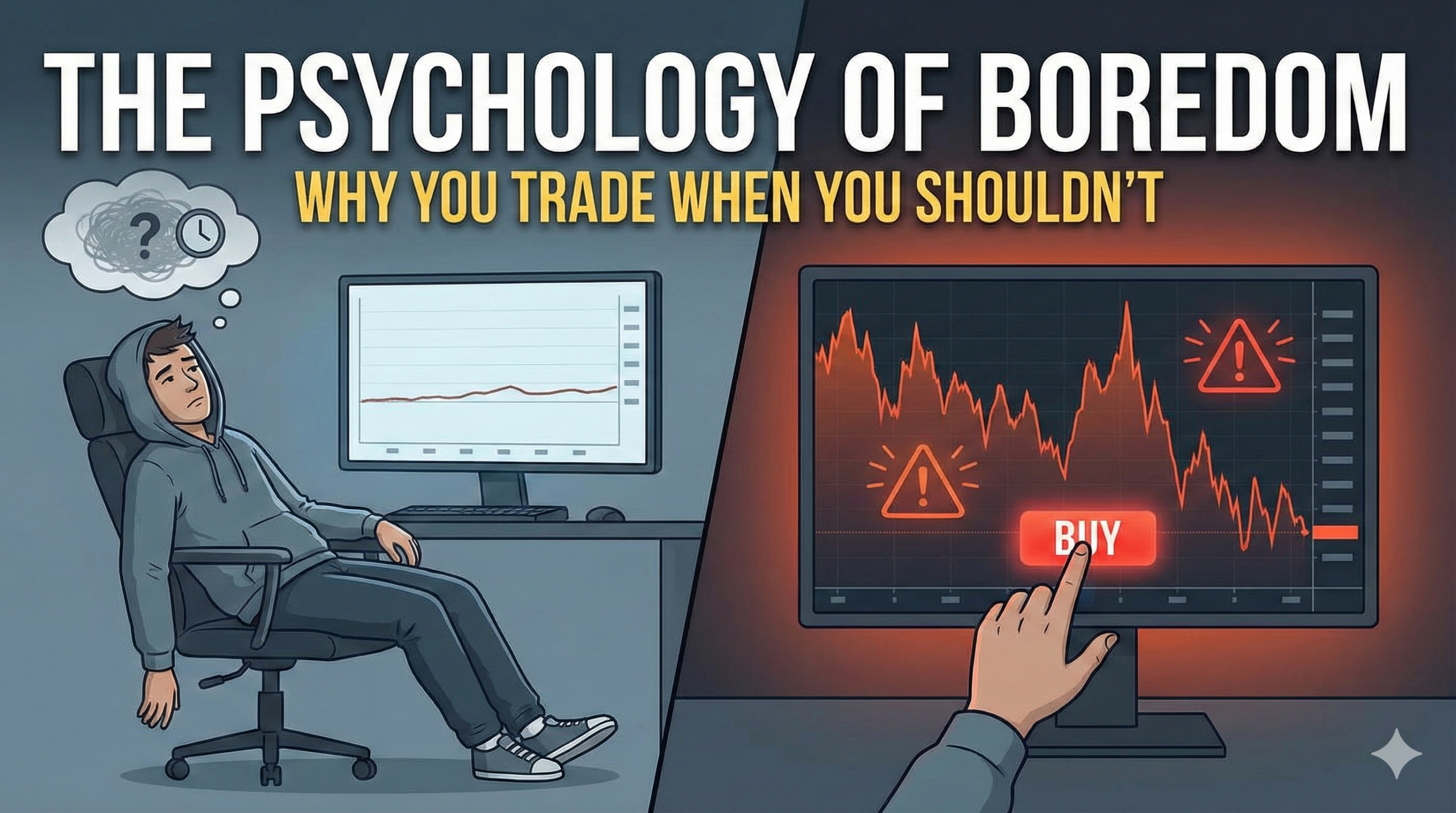
You have been sitting in front of your charts for two hours. Nothing has matched your setup criteria. The market is choppy and indecisive. You know you should just walk away, but instead you keep staring at the screens. Then it happens. A stock makes a little move that is not quite your setup, but close enough. Your finger hovers over the mouse. You tell yourself it might work. Before you know it, you are in the trade.
That was not a trade based on your edge. That was a trade to relieve boredom. Your brain got tired of waiting and craved action, stimulation, and something to do. Trading became the way to scratch that itch, even though nothing was actually there.
Boredom is one of the hidden enemies of good trading. It sneaks up on you during slow markets and long waits, and it makes you do things you know you should not do. If you do not learn to recognize and manage boredom, it will cost you money and keep you from developing real discipline.
What Boredom Does to Your Trading Brain
Your brain interprets lack of action as wasted time. You sat in front of charts for hours and did nothing. That feels unproductive. Your mind starts whispering that you should have at least tried something. Maybe you missed opportunities. Maybe you are being too cautious. The longer you sit with no action, the louder that voice gets.
The dopamine craving that builds when nothing happens is real. Your brain wants the hit of excitement that comes with entering a trade. Waiting provides no stimulation. No reward. No feedback. It is boring in the literal sense, and your brain does not like being bored.
How sitting still feels like failing at trading is a psychological trap. Traders are supposed to trade, right? If you are not trading, are you even working? This flawed logic makes inactivity feel like laziness or missed opportunity. In reality, not trading when nothing qualifies is exactly what good traders do. But it does not feel that way to your restless brain.
The psychological need to do something to justify your time becomes overwhelming. You cleared your schedule to trade today. You have been watching for two hours. If you do not take at least one trade, what was the point? This need to justify the time investment pushes you into taking trades that do not deserve your capital.
Why Boredom Makes You See Setups That Aren’t Really There
Your brain starts finding patterns to create action. Pattern recognition is helpful in trading, but when you are bored, your brain goes into overdrive looking for any excuse to trade. Suddenly everything looks like it might be a setup. That support level looks kind of strong. That volume spike might mean something. You are not seeing clearly anymore. You are seeing what you want to see.
Marginal setups start looking like good opportunities when you are desperate for action. A trade that you would have passed on instantly yesterday now seems reasonable. The difference is not the setup. The difference is that you have been sitting there bored for three hours and need something to do.
The mental gymnastics to justify taking a bad trade are impressive. You tell yourself maybe this will work. Your rules say one thing, but this situation feels different. You convince yourself it is close enough to your criteria. You find reasons to override your better judgment. All of this happens because boredom is running the show.
How desperation for stimulation overrides your rules is the core problem. Your trading plan says to wait. Your discipline says to pass. But your bored brain is screaming for action. When boredom wins that internal argument, you take trades you should not take. The need for stimulation beats the need to follow your edge.
The Hidden Cost of Boredom Trading
Every boredom trade is a leak in your account. Maybe it only costs you $40. Maybe it breaks even. But it was never part of your plan. It consumed mental energy, added risk, and most likely lost money. Do that three times a week, and you are bleeding hundreds of dollars a month to boredom.
How these small random trades add up over weeks is brutal when you actually calculate it. You might not notice one $35 boredom trade. But four of them in a week is $140. Over a month that is over $500. In a year, boredom just cost you $6,000 or more. That is the real price of not being able to sit still.
The confusion it creates when reviewing your performance makes improvement nearly impossible. You are trying to figure out if your strategy works, but your data is polluted with boredom trades. You can not measure your edge when you mixed your planned setups with random action trades. Your review sessions become frustrating because nothing is clear.
Reinforcing bad habits that are hard to break later is maybe the worst cost. Every time you trade out of boredom, you train your brain that it is okay to override your plan when you feel restless. You are building a habit of trading for stimulation instead of edge. That habit gets stronger each time you do it, and eventually it is almost automatic.
Recognizing When You’re Trading for Action, Not Edge
The feeling of needing to do something right now is the clearest sign. You are not thinking about your edge or your setup criteria. You are just feeling antsy and need to click a button. That urgency is emotional, not strategic. When you feel it, you are about to make a boredom trade.
Taking trades just to feel productive is another red flag. You tell yourself at least you tried something. At least you were active. But productivity in trading is not measured by activity. It is measured by execution quality. Taking a bad trade to feel productive is like eating junk food to feel healthy. It does not work.
The relief you feel when you click the button is the giveaway. If entering a trade feels like scratching an itch or relieving pressure, that was a boredom trade. A real setup based on your edge does not feel like relief. It feels like calm execution of your plan.
Warning signs that boredom is driving your decisions include trading more on slow days than on busy days with actual setups, feeling restless after thirty minutes of no action, entering trades you know do not quite match your criteria, and checking charts constantly hoping something appears.
How to Tell if Boredom Is Your Problem
You trade more on slow days than busy days with good setups. This is backwards. On days with clear setups, you might take one or two planned trades. On choppy slow days, you take five trades trying to force something. That pattern means boredom is your problem.
You feel restless watching charts with no action. Your leg bounces. You check other stocks not on your watchlist. You refresh your screens. You feel like you are wasting time. That restlessness is your brain demanding stimulation.
You enter trades you know do not quite match your plan. In the moment, you tell yourself it is close enough. But if you are honest, you knew it was not your setup. You took it anyway because sitting there doing nothing felt worse than taking a questionable trade.
You feel relief or excitement from just placing the trade. The actual outcome almost does not matter. You just needed to do something. That feeling of relief when you finally take action, regardless of whether it is a good trade, tells you everything you need to know.
What Professional Traders Do During Boring Stretches
Accept that most trading time is waiting. Professional traders know they might spend hours or even entire days without taking a single trade. They do not see that as failure. They see it as part of the job. Patience is not a nice to have skill. It is a requirement.
Use quiet time for education and review instead of forcing trades. When nothing is setting up, experienced traders review past trades, study their patterns, or work on their watchlist for tomorrow. They use the downtime productively without actually trading.
Step away from charts instead of forcing trades. If nothing is happening for an hour, professionals often just close their platform and do something else. They do not feel obligated to sit there the entire day. They trust that if a real setup appears, they can come back.
View boredom as confirmation they are being selective. When you feel bored because nothing qualifies, that means you are being appropriately selective. You are not lowering your standards just to create action. That is a win, not a waste of time.
Practical Ways to Combat Boredom Without Trading
Set a maximum screen time per day. If you decide you will only watch charts for two hours, you can handle the boredom better. You know it is temporary. You are not committing to sit there all day desperately looking for something to trade.
Have a specific task list for slow periods. When nothing is setting up, work on your watchlist for tomorrow. Review your journal from last week. Study a concept you do not fully understand. Having a plan for downtime prevents boredom from pushing you into bad trades.
Physical activities to break the sitting cycle help immensely. Set a timer for forty five minutes. If nothing has set up by then, go for a ten minute walk. Do some pushups. Stretch. Getting your body moving resets your brain and relieves the restless energy.
The power of just closing the platform cannot be overstated. If you have been watching for ninety minutes and nothing is happening, close everything and walk away. Come back in an hour. You are not going to miss the trade of the century in that time.
Building tolerance for doing nothing is a skill. Start small. Can you sit and watch charts for thirty minutes without forcing a trade? Then try an hour. Build your boredom tolerance like you would build any other muscle. It gets easier with practice.
Reframing Boredom as Part of the Job
Boredom means you are being disciplined. If you feel bored because you are not taking marginal setups, congratulations. You are doing it right. The boredom is proof that you are holding your standards high.
Waiting is active work, not wasted time. You are actively screening setups and rejecting the ones that do not qualify. That is valuable work. Just because it does not involve clicking buttons does not mean you are not working.
The best traders are bored most of the time. They take a few trades per week, maybe per day if they are day traders. The rest of the time they wait. If you want to trade like a professional, you need to be okay with being bored like a professional.
How to feel productive without taking trades is about redefining productivity. Did you follow your rules? Did you pass on setups that did not qualify? Did you avoid revenge trading? Then you were productive, even if you took zero trades.
The Bottom Line
Boredom will always be part of trading. Markets are not always moving. Good setups are not always available. You will have slow days, slow weeks, and long stretches where nothing matches your criteria. That is normal.
Your job is to not let boredom control your decisions. When you feel that itch for action, recognize it for what it is. Your brain wanting stimulation has nothing to do with whether a trade has edge. Do not let restlessness override your discipline.
Here is your action step this week. Track boredom trades separately. Every time you take a trade that you suspect was driven by boredom rather than edge, mark it in your journal. At the end of the week, add up the cost. Seeing the actual dollar amount you are paying for entertainment will change how you think about sitting still.
The market does not care if you are bored. It will not create a good setup just because you have been waiting for hours. Learn to be comfortable with boredom, and you will avoid one of the most expensive mistakes beginner traders make.